Key Findings
A 2026 study published in Frontiers in Physiology introduced a novel time-resolved modeling framework designed to disentangle "residual" autonomic effects from "stimulus-specific" responses during repeated cold water immersion protocols. Using continuous beat-to-beat cardiovascular monitoring in 68 participants undergoing three sequential 3-minute immersions at 10°C with 15-minute recovery intervals, researchers quantified how the autonomic nervous system adapts across exposures within a single session.
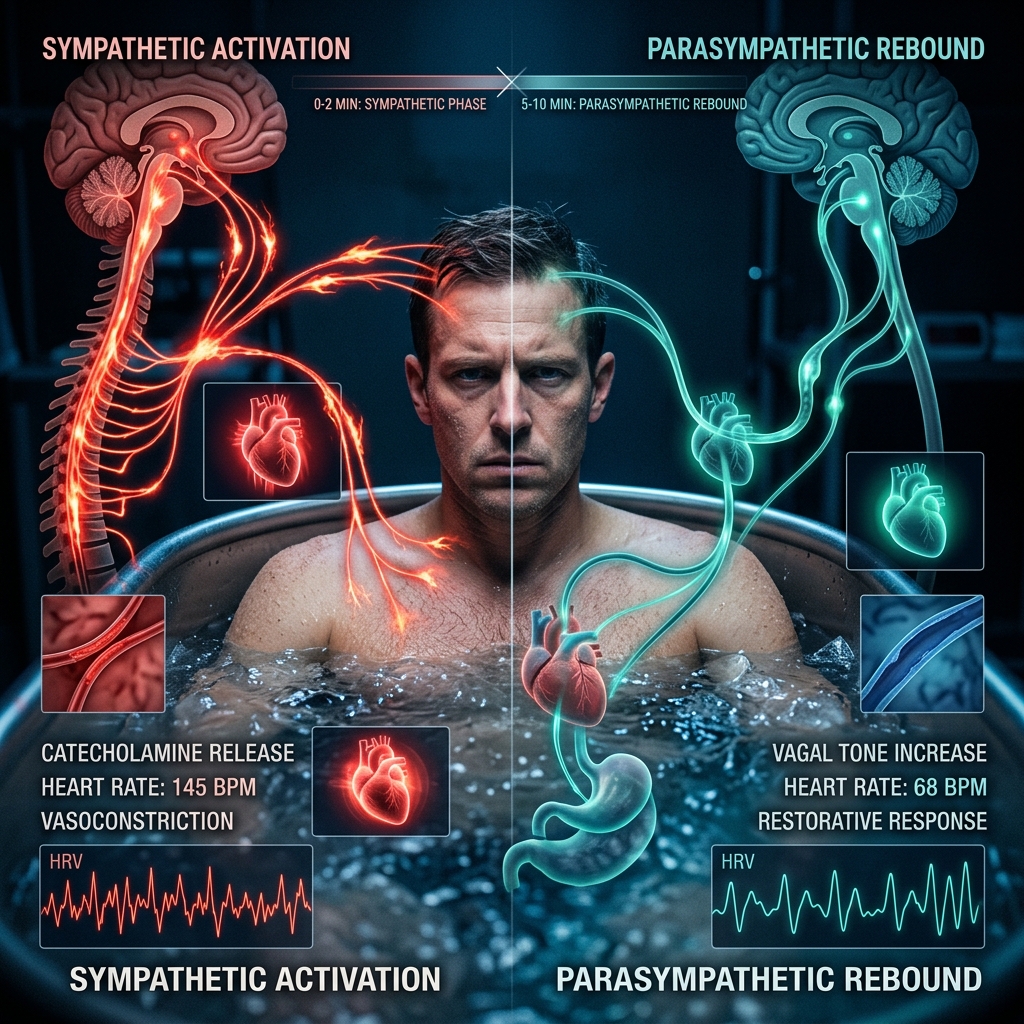
The first cold stimulus produced a pronounced autonomic shift — decreased heart rate, increased time-domain HRV variables (RMSSD +42%, SDNN +31%) — consistent with a strong parasympathetic rebound post-immersion. Subsequent exposures elicited attenuated but still additive responses, with the second and third immersions producing progressively smaller RMSSD increases (+28% and +19% respectively).
Recovery dynamics were also exposure-dependent: initial immersions required up to 60 minutes for full autonomic return to baseline, while repeated stimuli showed shortened recovery periods of 25-32 minutes. The modeling framework allowed researchers to separate the cumulative "baseline drift" from the acute stimulus response — revealing that the nervous system carries forward a residual parasympathetic bias that compounds across exposures.
Why This Matters for Body-Mind Practice
This study provides the first quantitative framework for understanding dose-response in cold exposure protocols. For practitioners designing cold plunge sequences, the data shows that multiple short immersions produce additive autonomic benefits with diminishing returns and faster recovery — supporting the common practice of progressive exposure within a single session. The finding that residual parasympathetic tone accumulates across exposures validates the experiential report from cold exposure practitioners that each subsequent plunge feels "easier" and suggests a measurable neurophysiological basis for cold adaptation training.
Source
- Time-resolved autonomic modeling of repeated cold water immersion. — Frontiers in Physiology