Key Findings
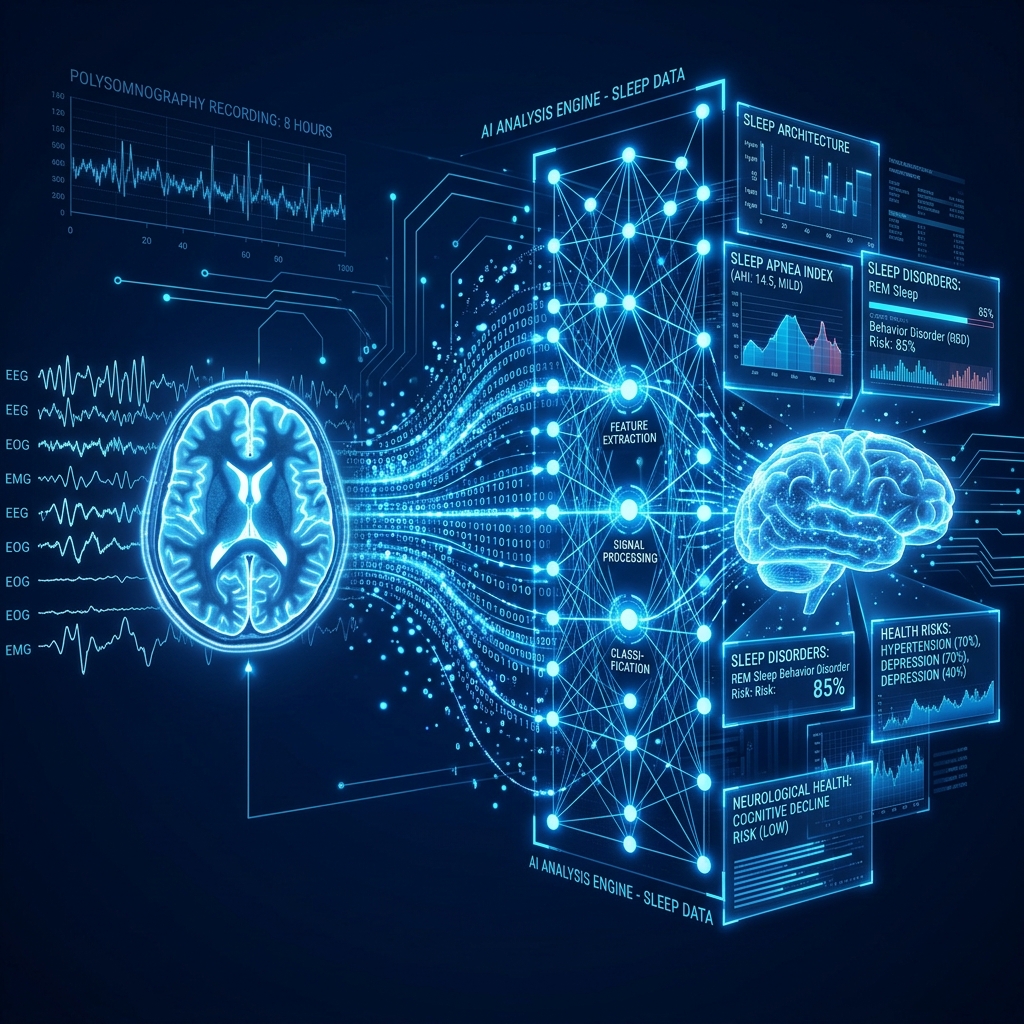
A landmark study from Stanford Medicine, published in Nature Medicine in 2026, demonstrated that an AI model trained on polysomnography (PSG) data can predict the future risk of over 130 health conditions — including cardiac arrhythmias, neurodegenerative diseases, respiratory disorders, and psychiatric conditions — with clinically meaningful accuracy years before symptom onset.
The model was trained on a dataset of over 14,000 overnight sleep recordings linked to longitudinal health records spanning up to 15 years of follow-up. Rather than relying on traditional sleep staging metrics (total sleep time, REM percentage), the AI extracted subtle features from raw EEG, EMG, EOG, and cardiorespiratory signals that are invisible to human scorers — including micro-architectural patterns in sleep spindle morphology, autonomic fluctuation signatures during NREM transitions, and respiratory event clustering dynamics.
For neurological conditions specifically, the model achieved area-under-the-curve (AUC) values exceeding 0.80 for predicting Parkinson's disease (AUC = 0.87, up to 7 years prior), Alzheimer's disease (AUC = 0.82, up to 5 years prior), and epilepsy (AUC = 0.84). Cardiovascular predictions — including atrial fibrillation and heart failure — also showed strong predictive performance.
Why This Matters for Body-Mind Practice
Sleep is the nervous system's nightly self-diagnostic — and this study demonstrates that AI can read that diagnostic report with extraordinary precision. For body-mind practitioners, the implications are profound: sleep architecture may be the single most information-dense biomarker of overall nervous system health. As consumer wearables approach research-grade accuracy, this technology could enable early detection of autonomic, neurological, and psychiatric conditions through routine home monitoring — transforming sleep tracking from a wellness metric into a genuine clinical screening tool.
Source
- AI predicts health conditions from overnight sleep recordings. — Nature Medicine