Key Findings
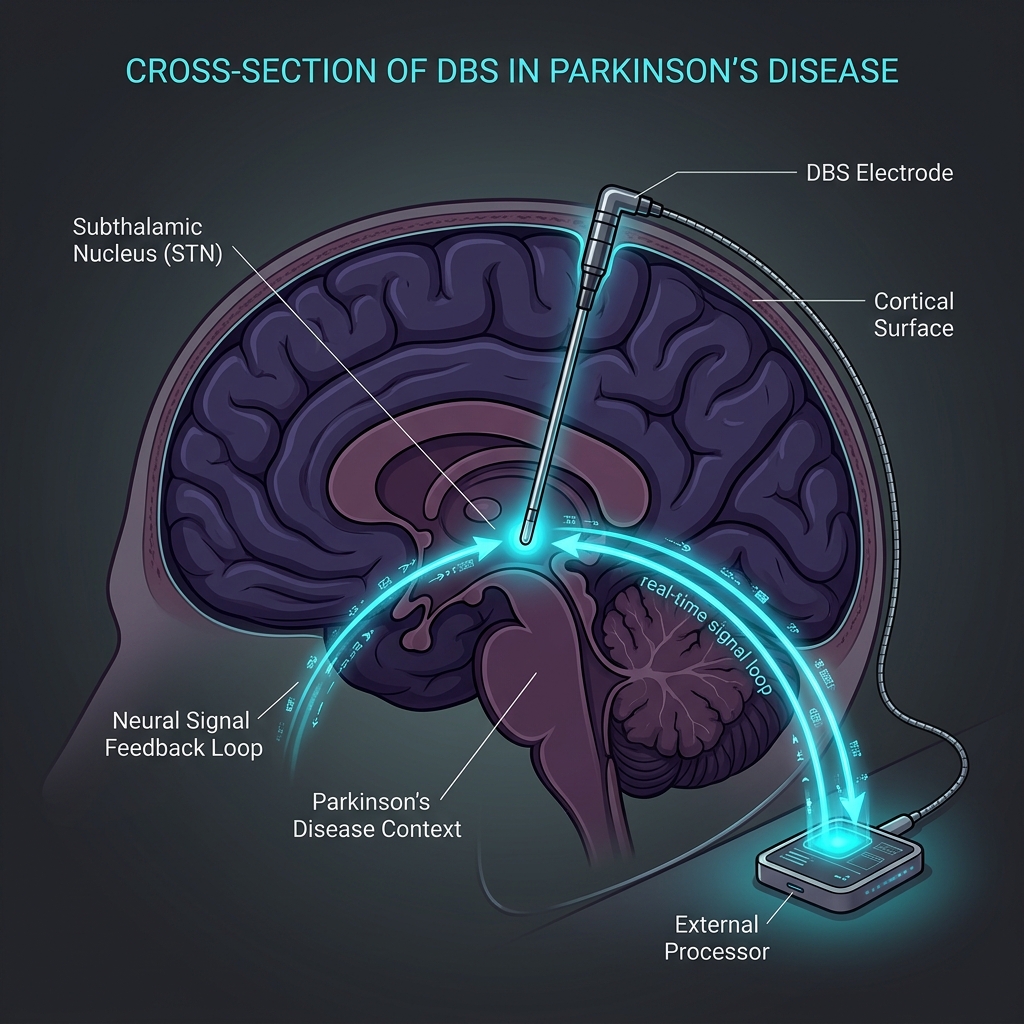
Objective.Deep brain stimulation (DBS) for neuropsychiatric disorders increasingly relies on patient personalized approaches. One strategy to identify viable targets for personalized stimulation and biomarker detection uses a temporary, inpatient stereoelectroencephalography (sEEG) trial to identify optimal targets for permanent re-implantation. However, this approach reasons that neural signals are stable between repeated intracranial electrode implants, which is not yet validated.Approach.We characterize the spectral stability of local field potentials after electrode reimplantation from an ongoing single-center clinical trial using two-staged sEEG/DBS for chronic pain (NCT04144972).Main results.Repeat neurosurgical implant of intracranial electrodes reliably targeted intended trajectories across staged surgeries occurring months apart (2.1 ± 1.2 mm Euclidean distance across 17 brain targets, 5 participants). Anatomical targeting error was correlated with differences in recorded electrophysiological power spectra between stages (r(15) = 0.51,p= 0.03). This correlation was stronger for the subset of regions re-targeted exclusively for biomarker sensing (r(6) = 0.73,p= 0.04), and non-significant for therapeutic stimulation sites (r(7) = .23,p= 0.76). Similarly, a multiple regression model significantly predicted spectral distance (F(4, 13) = 5.99,p= 0.008, adjustedr= 0.70) with an interaction between electrode type and Euclidean distance (t(13) = 2.39,p= 0.03).Significance.Chronic intracranial EEG (iEEG) signals recapitulated temporary recordings in 17 of 17 brain regions with the major spectral peak within 1 Hz. Our results demonstrate the temporal stability of neural signals across months and validate the use of a two-staged iEEG approach for chronic DBS sensing in humans.
Why This Matters for Body-Mind Practice
[Draft — editorial context needed]
Source
- Human intracranial signal stability tracks anatomical accuracy after electrode reimplantation. — Journal of neural engineering
- Journal of neural engineeringRead Source →